
Your electricity bill in Spain, explained line by line

You get home, open your post or your email, and find your Spanish electricity bill. Six different items, and a total you have no idea how to account for. This guide explains what each line of your electricity bill means, what IVA is, and why your bill can go up from one month to the next even if you haven't used any more electricity.
What makes up a Spanish electricity bill
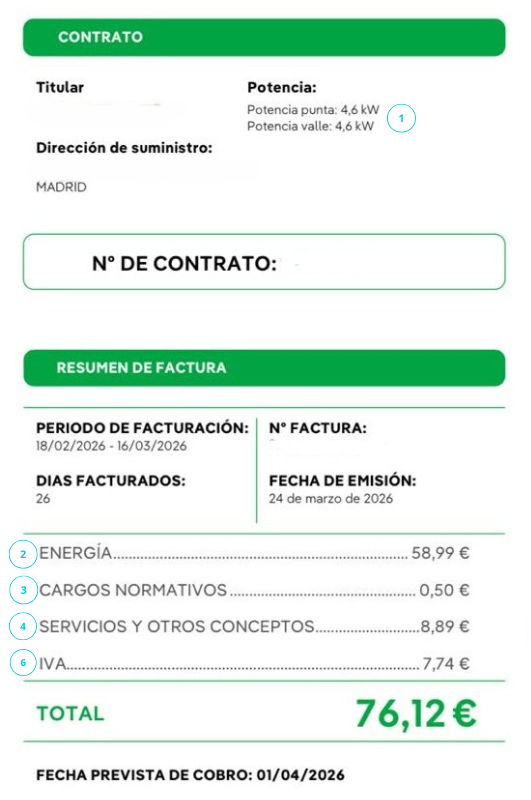
A typical Spanish electricity bill has six main components, although additional charges may appear depending on your situation. Two of them, the power charge and the energy charge, are the same as you would find in any country. The other four, the meter rental, the social bonus levy, the IEE, and the IVA, are specific to the Spanish regulatory system, and that is where the confusion usually starts.
- Power charge (Término de potencia). This is the fixed monthly charge you pay regardless of whether you switch on a single light. It is calculated by multiplying the contracted power capacity (in kilowatts, kW) by the price set for that band and the number of days in the billing period. On your bill you will see something like: X kW × price/kW × days. If you have never reviewed your contracted power, there is a good chance you are paying for more than you actually need.
- Energy charge (Término de energía). This is the variable part of your bill. It is calculated by multiplying the kilowatt-hours (kWh) you have consumed during the billing period by the price per kWh on your contract. On your bill you will see something like: X kWh × price/kWh. If you are on the regulated PVPC tariff, that price fluctuates hour by hour according to the wholesale market, so the final figure is the weighted average across all hours in the period. If you are on a fixed-price tariff in the free market, you can check current electricity prices in Spain to see how they compare.
Regulatory charges:
Social bonus levy (Financiación del bono social). This is a small charge that appears on every Spanish electricity bill. All consumers contribute to funding the social bonus, a discount applied to households in a situation of energy vulnerability. The IEE and IVA also apply to this charge.
IEE (Impuesto Especial sobre la Electricidad — Special Electricity Tax). A specific levy applied to the power charge, the energy charge, the meter rental, and the social bonus levy combined. It normally amounts to 5.11% of those items, although since 22 March 2026 it has been temporarily reduced to 0.5%.
- Meter rental (Alquiler del contador). In Spain, the smart meter installed at your property is usually located in the communal hallway of the building and in most cases belongs to the distribution company, which rents it to you on a monthly basis. In some cases, however, you may own it outright. The rental charge is regulated at a national level and is the same regardless of which supplier you have chosen. It is typically between €0.80 and €1.00 per month.
- IVA. Applied at the end, on top of all the items above. The next section explains exactly how it works and what the current rate is.
In addition to these six items, your bill may include other charges depending on your situation: promotional discounts applied by your supplier, or monthly fees for maintenance services if you have them contracted. The IEE and IVA also apply to all of these.
What is IVA on a Spanish electricity bill?
IVA (Impuesto sobre el Valor Añadido) is the Spanish consumption tax, equivalent to VAT in the United Kingdom, GST in Australia, or TVA in France. If you come from the UK or Ireland, the concept will be familiar. If you are from the United States, where there is no equivalent federal tax on domestic energy, the surprise may be greater: a line that adds between 10% and 21% on top of everything else is something you are probably not used to seeing.
There are two things about Spanish electricity IVA that are worth understanding from the outset.
It applies to everything, including previous taxes. The IVA tax base includes the power charge, the energy charge, the IEE, and the meter rental all added together. In other words, you pay IVA on the IEE, which is itself a tax. This is legal and regulated, but it explains why the IVA amount always seems higher than you might expect.
The rate varies depending on the energy market situation. The standard IVA rate in Spain is 21%. However, when energy prices rise significantly, the Government can apply a temporarily reduced rate by means of a Royal Decree. This has happened several times since 2021, and in March 2026 it was applied again.
What is the current IVA rate on electricity?
Since 22 March 2026, the IVA on electricity has been reduced from 21% to 10% as part of the Comprehensive Response Plan to the Middle East Crisis. The measure is applied automatically, you do not need to do anything, and it applies to all contracts with a contracted power of up to 10 kW, both in the free market and the regulated market. The measure is currently set to remain in place until 30 June 2026.
Is IVA the same across all of Spain?
No. Spain has three different tax regimes depending on the territory. If you live in the Canary Islands, Ceuta, or Melilla, your bill works differently from the rest of the country.
Mainland Spain and the Balearic Islands. Standard IVA applies. Currently at 10% on a temporary basis, with a return to 21% expected from 1 July 2026.
Canary Islands. IVA does not apply here. Instead, the IGIC (Impuesto General Indirecto Canario — Canary Islands General Indirect Tax) is used. The standard rate is 7%, but for residential properties with a contracted power of 10 kW or less, the energy consumed and the power charge are taxed at 0%. Only the meter rental is subject to IGIC at 7%.
Ceuta and Melilla. Neither IVA nor IGIC applies here. Instead, the IPSI (Impuesto sobre la Producción, los Servicios y la Importación — Tax on Production, Services and Imports) is used. The rate for energy and power is 1%, while the meter rental and associated services are taxed at 4%.
| Territory | Tax | Energy + power (residential) | Meter rental | Gov. reductions |
|---|---|---|---|---|
| Mainland + Balearic Islands | IVA | 10% (<10kW) / 21% (other) | 10% | Yes, apply |
| Canary Islands | IGIC | 0% (residential) / 3% (non-residential) | 7% | Do not apply |
| Ceuta and Melilla | IPSI | 1% | 1% | Do not apply |
* 10% on a temporary basis until 30 June 2026. From 1 July 2026, the rate returns to 21%.
How would a bill look across the different territories?
About this simulation: The three bills below are based on the same contract and consumption applied to each territory. Offer: Endesa Luz Fija 24 Horas (fixed-price tariff, free market). Contracted power: 4 kW (P1 peak) + 4 kW (P2 off-peak), 2.0TD access tariff. Consumption: 270 kWh over a 30-day billing period. Power price: 0.09367 €/kW/day. Energy price: 0.1200 €/kWh. IEE rate: 0.5% (temporarily reduced since 22 March 2026).
Mainland Spain and the Balearic Islands — IVA
| Concept | Calculation | Amount |
|---|---|---|
| Power charge — P1 (peak) | 4 kW × 30 days × 0,09367 €/kW/day | 11,24 € |
| Power charge — P2 (off-peak) | 4 kW × 30 days × 0,09367 €/kW/day | 11,24 € |
| Energy charge | 270 kWh × 0,1200 €/kWh | 32,40 € |
| Social bonus levy | 30 days × 0,01912 €/day | 0,57 € |
| Meter rental | 30 days × 0,02663 €/day | 0,80 € |
| Subtotal | 56,25 € | |
| IEE — Special Electricity Tax (0,5%) | 56,25 € × 0,5% | 0,28 € |
| Tax base (base imponible) | 56,53 € | |
| IVA (10%) | 56,53 € × 10% | 5,65 € |
| Total | 62,18 € |
IVA temporarily reduced to 10% until 30 June 2026 for contracts with up to 10 kW of contracted power. The standard rate of 21% returns from 1 July 2026. IVA applies to the full tax base, including the IEE.
Canary Islands — IGIC
| Concept | Calculation | Amount |
|---|---|---|
| Power charge — P1 (peak) | 4 kW × 30 days × 0,09367 €/kW/day | 11,24 € |
| Power charge — P2 (off-peak) | 4 kW × 30 days × 0,09367 €/kW/day | 11,24 € |
| Energy charge | 270 kWh × 0,1200 €/kWh | 32,40 € |
| Social bonus levy | 30 days × 0,01912 €/day | 0,57 € |
| Meter rental | 30 days × 0,02663 €/day | 0,80 € |
| Subtotal | 56,25 € | |
| IEE — Special Electricity Tax (0,5%) | 56,25 € × 0,5% | 0,28 € |
| Tax base (base imponible) | 56,53 € | |
| IGIC — power, energy and social bonus (0%) | Exempt for residential ≤10 kW | 0,00 € |
| IGIC — meter rental and other services (7%) | 0,80 € × 7% | 0,06 € |
| Total | 56,59 € |
In the Canary Islands, IGIC replaces IVA. Power and energy are taxed at 0% for residential supplies with up to 10 kW of contracted power. Only the meter rental and other contracted services are subject to IGIC at the standard rate of 7%. Government reductions applied on the mainland (IVA, IEE) do not apply here.
Ceuta and Melilla — IPSI
| Concept | Calculation | Amount |
|---|---|---|
| Power charge — P1 (peak) | 4 kW × 30 days × 0,09367 €/kW/day | 11,24 € |
| Power charge — P2 (off-peak) | 4 kW × 30 days × 0,09367 €/kW/day | 11,24 € |
| Energy charge | 270 kWh × 0,1200 €/kWh | 32,40 € |
| Social bonus levy | 30 days × 0,01912 €/day | 0,57 € |
| Meter rental | 30 days × 0,02663 €/day | 0,80 € |
| Subtotal | 56,25 € | |
| IEE — Special Electricity Tax (0,5%) | 56,25 € × 0,5% | 0,28 € |
| Tax base (base imponible) | 56,53 € | |
| IPSI (1%) | 56,53 € × 1% | 0,57 € |
| Total | 57,10 € |
In Ceuta and Melilla, IPSI replaces both IVA and IGIC. The rate is 1% and applies to the full amount of the bill, with no distinction between concepts. Government reductions applied on the mainland do not apply here.
Compare and save on your bill in under 2 minutes
Frequently asked questions
Can I reduce what I pay?
If you have been in Spain for a while and have never compared suppliers, it is worth doing. Prices vary significantly between companies in the free market, and if your priority is cost, you can also opt for the regulated market. Switching supplier is straightforward: the process takes a maximum of 10 working days from the moment your contract is formalised, extendable by a further 5 working days in complex cases, and your supply is never interrupted.
Free personalised energy advice
Can I negotiate the IVA or the IEE?
No. Both are taxes set by law and applied automatically, regardless of which supplier you are with.
Why is my bill higher this month than last month if I used the same amount of electricity?
There are several possible reasons: a change in the IVA rate, a rise in the energy price on the wholesale market if you are on a PVPC tariff, an adjustment to your contracted power, or the fact that your contract has expired and new conditions are now being applied, such as updated prices or the removal of discounts you had during the previous year. First, check whether the IVA rate on your bill matches the one in force at the date of issue, and check whether a year has passed since you signed your contract. You can find this in the contract details section of your bill or in your supplier's online account area.
How do I know if I am paying too much for my contracted power?
Check your bill for the maximum power demand during the billing period — many bills show this figure explicitly. If that value is well below your contracted power, you may be able to reduce it and pay less on the fixed power charge. You can request a review at no cost.
Does switching supplier affect the taxes I pay?
No. The IVA, the IEE, and the meter rental are the same with any supplier. What changes when you switch is the energy price — you can compare the cheapest electricity deals in Spain — and the power charge.